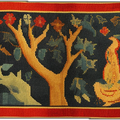
The villagers made a certain traditional kind of rug, on handlooms, with a certain limited range of colors from vegetable dyes they made themselves – a blood-red, a dark blue with a hint of green, a sandy yellow, a charcoal black. There were a few traditional designs, which hardly varied: a branching tree, with fruit like pomegranates, and roosting birds, somewhat like pheasants, or a more abstract geometrical design, with discs of one color threaded on a crisscrossing web of another on the ground of a third. The rugs were on the whole made by the women, who also cooked and washed.





![Viy from Wikipedia-art-scale-4 00x Sccy6 please credit[palette.fm]](../../../_data/i/upload/2023/12/02/20231202001249-a5a89592-sq.jpg)





![469ecc20-4bc1-4282-9a73-5c9b38a8badd [MJ upscaled]](../../../_data/i/upload/2023/12/02/20231202000247-013bfdd5-sq.jpg)